
by Bob Ferris
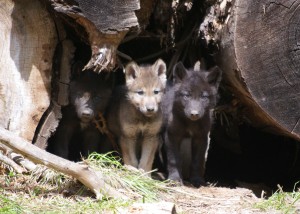
When I was in high school the Viet Nam conflict was still in full swing and so was the draft. And as we neared graduation our guidance counselors had us take aptitude tests. Invariably all the aptitude test results for males—regardless of input—indicated a suitability for the military. I think about it now, because as I look at actions and legislation coming out of many of the wolf-occupied states in the West, regardless of the complex, multi-layered conditions or scientific input implicating non-wolf causes for elk and other prey declines, we keep seeing the same answer: We need to kill more wolves faster.
This becomes more pertinent as yet another study comes out on elk that indicates that what might be driving elk reproductive success and also winter survival is the quality of summer elk habitat. This is almost painfully obvious as fat content in females drives reproductive success in mammals. And if you are not well fed and fat when you go into winter, you are going to come out of winter literally skin and bones—and nothing else (i.e., dead).
When we look at the factors effecting summer range in the above article we see a few mentioned but two critical ones are absent. The first is climate change. Prolonged draught has in some areas reduced the amount of grasslands and shortened the time that vegetation is green and most useful to elk (please see here and here). This should not be surprising as we are seeing the same climate effects for agriculture.
I have heard that this green season has been shorted in some places as much as seven days which means roughly a 5-10% reduction. This may not seem like much until you throw in the other factor: Cattle grazing. Elk may very well be able to weather (sorry) this drop but not if they are already feeding on steeper slopes and in lower quality habitats because they have been displaced by cattle or their grasses have already been eaten by domestic sheep.
These important alternative hypotheses to the localized reductions in elk or other prey populations that are supported by research seem to be ignored by many decision makers, but they are by no means the only ones that contradict the mantra of the anti-wolf crowd. Other research, for instance, has talked about the long term impacts of too many ungulates (native, wild or both) on the habitat as well as the impacts of other predators—cougars, grizzlies and humans—playing a more important part in these declines. Natural succession or the tendency for habitats to mature and become less ungulate-friendly as they transcend from grassy to brushy to forest has also been mentioned as an influence on elk populations. But none of these factors or alternatives seem to enter into the debate when there is this easier management off-ramp in livestock industry-influenced legislations and wildlife agencies: Kill more wolves faster (KMWF).
Right now where this KMWF answer is most dominant—the Northern Rockies—we are losing nearly a wolf and half a day or more than one mile of wolves laid nose to tail over the last two years—at a minimum. In the absence of science and restraint, the well intentioned delisting experiment in the Rockies is failing miserably, cruelly and embarrassingly. And the whole world is watching.
Because of the above and the opportunities to learn from this tragic mistake, Cascadia Wildlands and a host of other science-driven conservation organization are promoting a congressional colleague letter being circulated by Congressmen Peter DeFazio and Ed Markey. The letter urges the Director of the US Fish and Wildlife Service Dan Ashe to listen to scientists and wildlife advocates who believe that federal protections for the wolf must be maintained in order to allow recolonizing wolves to reclaim viable habitats—mainly on federal lands—in the Pacific Northwest, California, the Southern Rockies and elsewhere. They are currently collecting member signatures for this letter.
We all should continue to fight for wolves in the Northern Rockies and also urge our own congressional representatives to sign on to this letter. Please ask them to stand up for wolves, science, and supporting the original intent of the Endangered Species Act. Please click here to take action.